
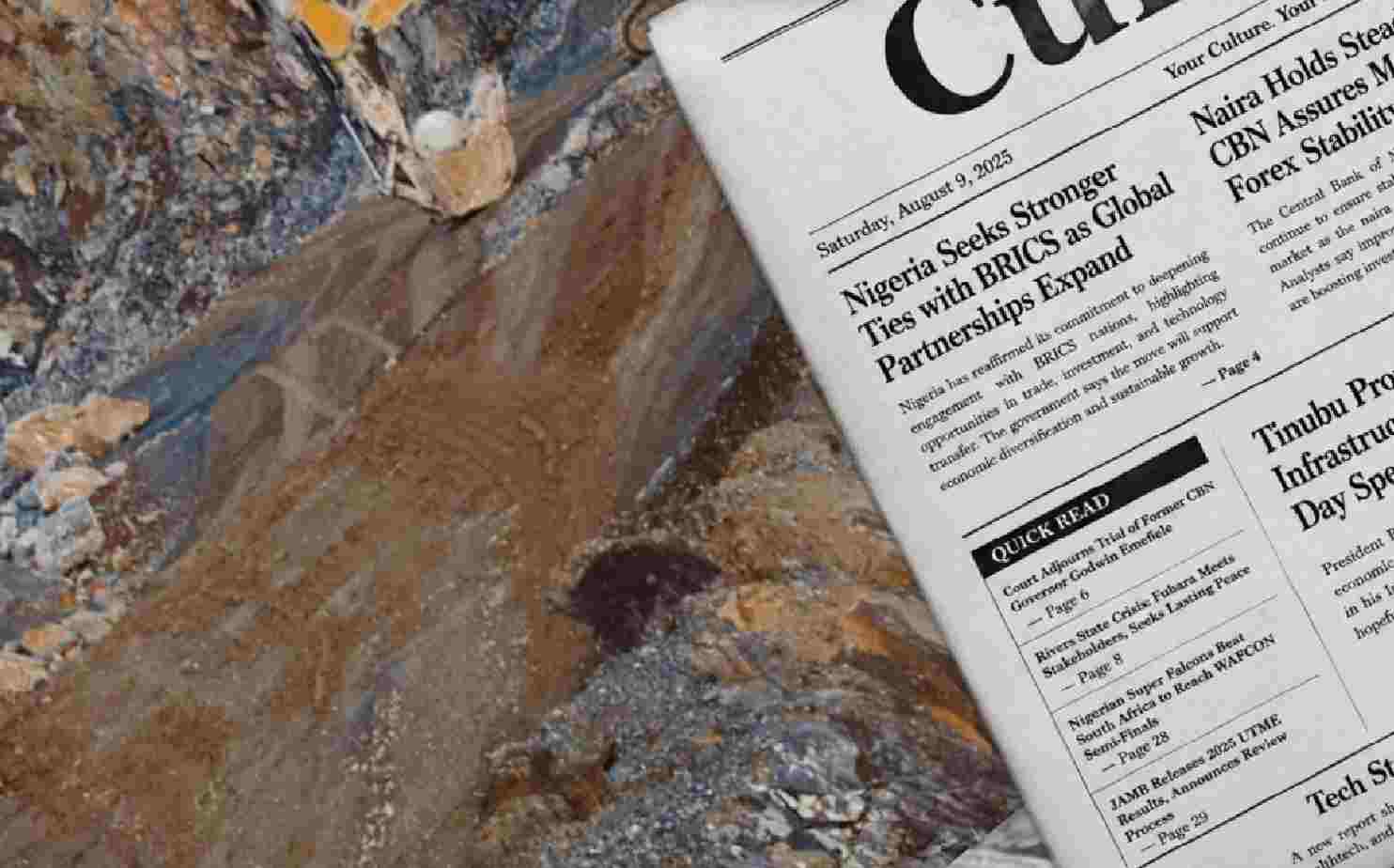
Fresh videos showing large-scale illegal mining activities in Mayam village, Taraba State, have sparked concerns over environmental safety, national security and the enforcement of Nigeria’s mining laws.
Reports indicate that miners from different parts of Nigeria, as well as foreigners from Libya and Egypt, have reportedly converged on the community following the discovery of gold deposits in the area. The development has raised questions about how mining activities could continue on such a scale despite the suspension of mining operations in Taraba State.
The discussion highlighted that mining activities in the state were suspended in June, with authorities warning that unregulated mining could worsen existing security challenges.
- INEC Trying to Reduce Vote-buying for 2027 Election as it Pleads for Media Support

- After Over 100 Years of Malaria Surveillance and Research in Nigeria, FG Targets Elimination With Health Financing
- Journalists Demand Better Welfare and Stronger Regulation of New Media



The Failure of Law Enforcement
An expert who discussed the development pointed to the Nigerian Minerals and Mining Act of 2007, which provides the legal framework governing the country’s mineral resources. According to the expert, the law vests ownership of mineral resources beneath Nigerian soil in the Federal Government.
The problem, he argued, is therefore not necessarily the absence of legislation but the difficulty of enforcing it. The situation in Mayam was compared with historic gold rushes in places such as California, Australia and Canada’s Klondike region, where rapid discoveries of valuable minerals attracted large numbers of miners.
However, unlike those historical rushes, Nigeria already has a legal and regulatory framework governing mining activities. The challenge is ensuring that those rules are actually enforced.
The expert noted that the Federal Ministry of Solid Minerals Development has taken several measures aimed at bringing artisanal miners into the formal mining system. One of those efforts has involved attempts to register artisanal miners so that their activities can be properly monitored and regulated.
The government has also sought to revoke certain mining licences and review existing cadastral allocations. More recently, the ministry has introduced technology-based surveillance of mining sites as part of efforts to improve monitoring.
However, the scale of illegal mining in some areas suggests that these measures have yet to completely solve the problem. A major concern raised in the discussion was the belief that illegal mining is not driven solely by poor individuals searching for livelihoods.
The expert argued that significant financial interests and substantial capital are often involved in illegal mining operations. This raises questions about who finances the operations, who controls access to mineral deposits and who ultimately benefits from the extraction and sale of illegally mined resources. According to the expert, the inability to effectively confront powerful individuals allegedly connected to illegal mining remains one of the central challenges facing enforcement.
The argument suggests that arresting individual miners at mining sites may not be enough to dismantle the networks supporting illegal extraction.
Security Concerns Extend Beyond Taraba
The issue is also increasingly being viewed as a national security challenge. The expert noted that illegal mining frequently occurs in areas already affected by insurgency, banditry and other forms of insecurity.
The concern is that the large amounts of money generated by illegal mineral extraction could interact with existing criminal networks.
Mining sites in remote areas can also be difficult for government agencies to monitor, potentially creating spaces where criminal groups can operate with limited oversight.
The concern is therefore not restricted to Taraba.
The expert pointed to other states where illegal mining has reportedly occurred, including Zamfara and Osun, while noting that discoveries of gold and lithium in different parts of the country could intensify competition for mineral resources.